
She Shares Her Driving Ambition to Be Exactly Where She is and What She Intends to Do About It; A Must Read for All FERC Practitioners
By Gary E. Guy and David Martin Connelly
Access the PDF version of this article here.
This is the true tale of a refugee’s daughter who, despite all odds – nay, because of the long odds – went after and attained job after job that was supposed to be foreclosed to her. Unselfishly, she offers herself as a mentor to young attorneys who ask and sets appointments with them upon request.
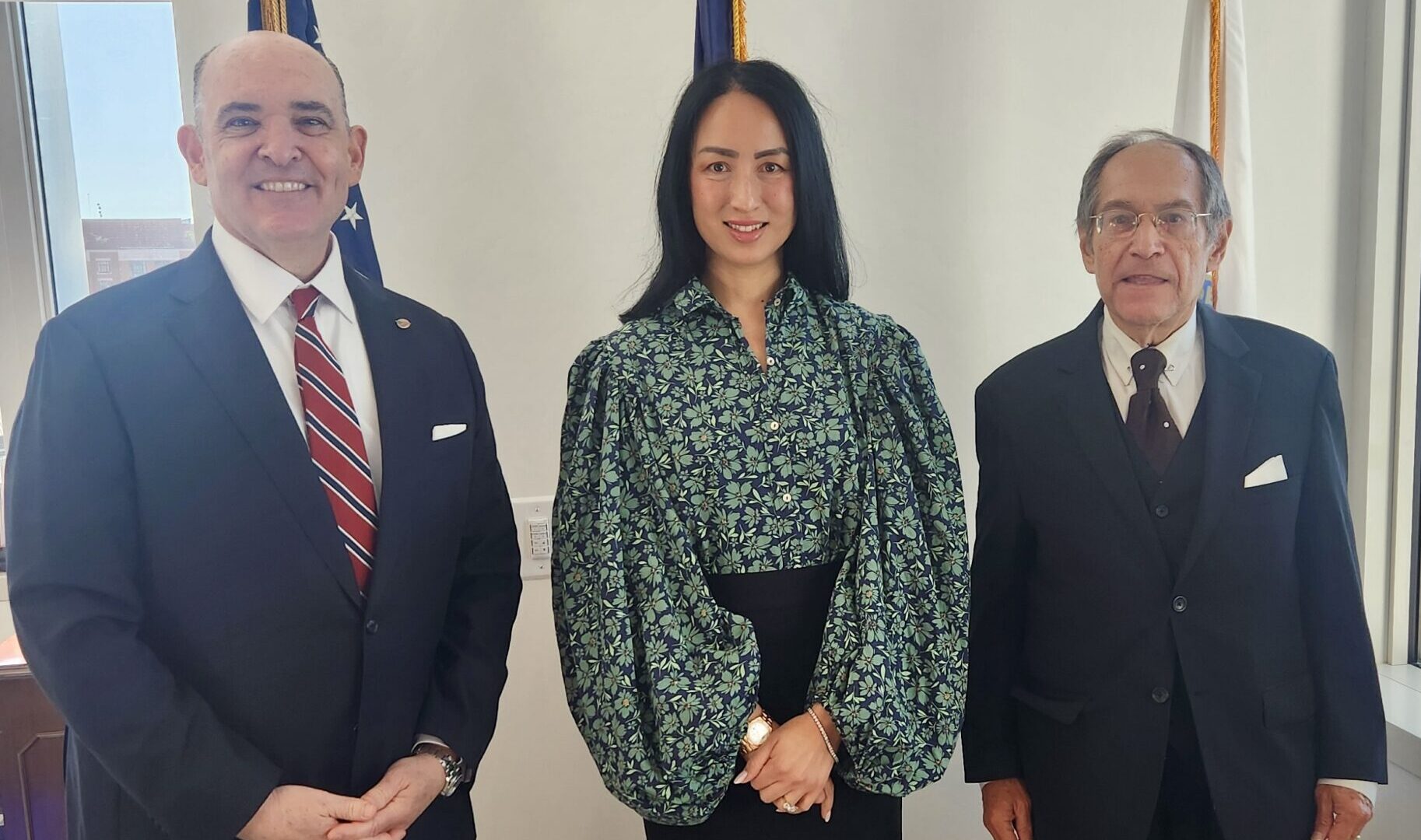
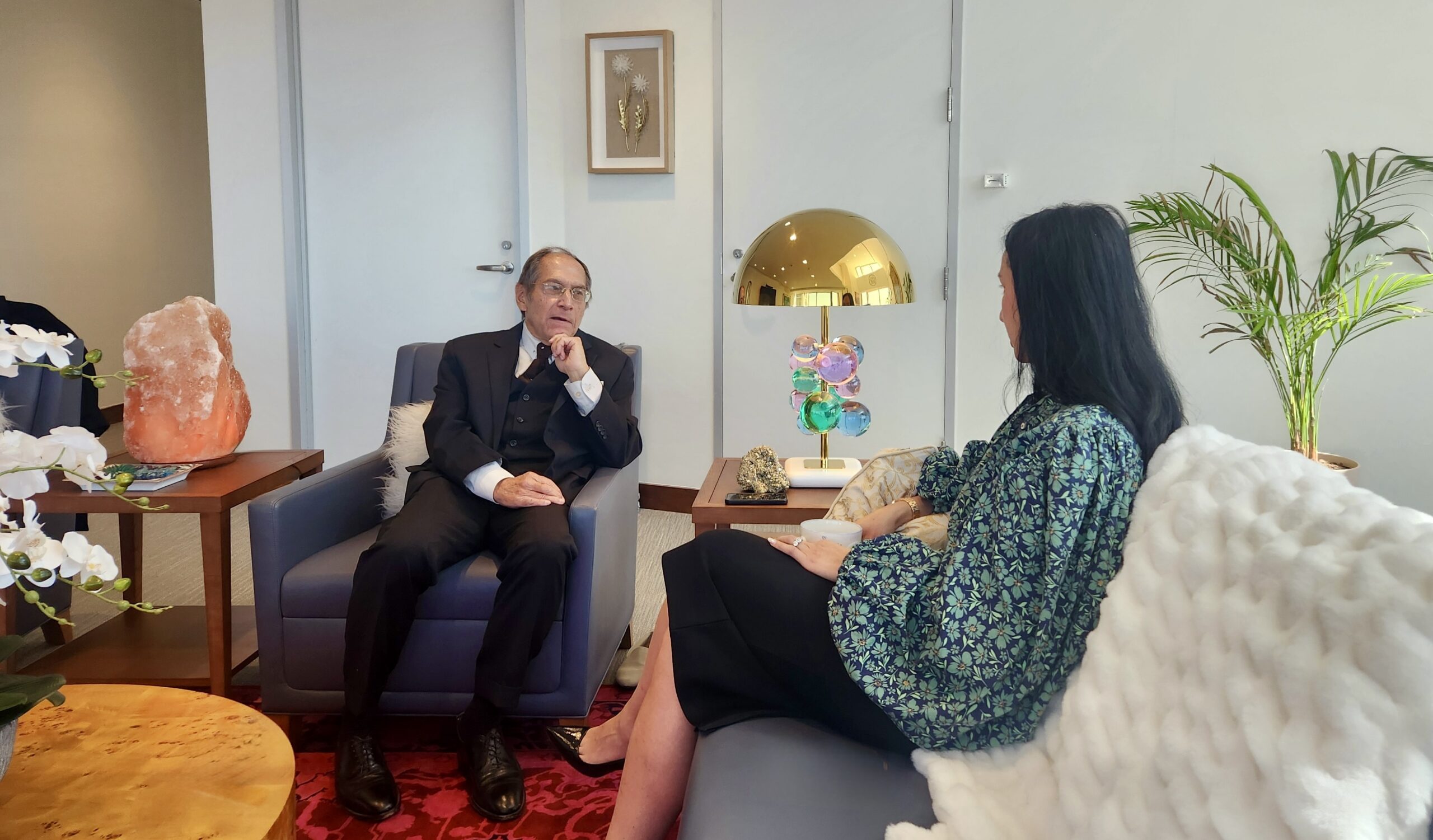
Nominated by President Trump on June 2, 2025, and confirmed by the Senate on October 7, 2025, Laura V. Swett is serving as FERC Chairman for a term expiring on June 30, 2030. Intrepid EBA interviewers Gary E. Guy and David Martin Connelly (aka “Elie Abel and Hal Bruno”) are thrilled to present to you this recap of our riveting sit-down conversation with her in late April. It was like no other interview we have ever been honored to do before.
A Public Spirited, Goal Oriented Achiever Lands Her Dream Job
Many at FERC have known her from her 15 years as a FERC practitioner, representing generating utilities, transmission owners, and natural gas and liquids pipelines at four law firms, most recently Vinson & Elkins. They also know her from previous FERC employment advising the late lamented Chairman Kevin McIntyre and Commissioner Bernard McNamee and serving as a lead attorney in the Office of Enforcement. This honors graduate from Georgetown University Law Center (which she attended at night her first year while interning for a Congressman) also holds a Bachelor of Arts degree from the University of Virginia and attended a science and technology high school in the Old Dominion, the land of her birth, where she resides with her husband and two young children, ages 1 and 5 (the eldest about to graduate from kindergarten).
“I still pinch myself when I walk into my office and see the plaque with my name on it!”

“My whole career” was her response when we asked her when she first aspired to be FERC Chairman. By that she means as a law student reading Order No. 888, not understanding it but being fascinated by its complexities and “imbued with the sense of its importance.”
Dear Reader, do not tell Laura Swett that she cannot do something. That is what happened in a class, taught by a former FERC Chairman, who laughed when she said she wanted to hold that high office herself. That dismissiveness made her “want to do it a thousand times more.” And achieve it she has! As she put it, “I like a challenge!” As you will see below, this was not the first time she overcame the odds, and we predict it will not be the last.
“I still pinch myself whenever I walk into my office and see the plaque with my name on it!” She thanks God every night “for the privilege of serving our country.” She correctly observes that she is younger than her predecessors but with more FERC experience “at least in the law, than many of them.” Consequently, most issues have precedent that she has experienced first-hand as a FERC practitioner, giving her an advantage over many former Chairmen. Even being so well equipped, the role constantly requires so many decisions that “my brain is stretched to capacity every single day.” But that is not a complaint. Instead, she concludes, “And I love it!” It is both much more demanding and thrilling than billing 3,000 hours a year in private practice because it is more all encompassing in scope. “I am pleased to learn that I really love making decisions!” She does not look back, but moves on to the next matter, producing products much faster than FERC Staff has experienced in prior Administrations. Our takeaway: Experience counts!
The Ascent: Never Yielding, Always Climbing
To understand this goal-oriented drive, it is necessary to know of her being raised with a strong “refugee survival mentality” from her Vietnamese mother and grandmother, and her awareness of her father of modest means growing up in Brooklyn before working at the Pentagon for over 40 years. “My parents raised me with a certain tenacity, an inability to take no for an answer.” Her parents also admonished her that “you have to find a job that will always pay well because you never know when you can lose everything.” They have lived to see her success, and they frequently cry with pride since her success has made all their sacrifices worthwhile. “It really motivates me,” she says of their example. She obviously learned their astute teachings well.
She explained that her parents also instilled in her a sense of mission that made her want to devote herself to a cause that “would be critical to the lifeblood of the country.” From “a formative young age” she saw that this purpose could best be achieved in energy. Clearly, she is a dedicated public servant for the sake of the cause more than for the prestige of the title.
It is the duality of service to country and achieving success that her parents longed to see her attain that helps her to cope with the downside of missing so much of her young children’s lives. “It’s very difficult. I have sacrificed time with my children for the country for this time in my life.” She knows that they are safe and well cared for, but it hurts when her son asks why she cannot attend an event at school like all the other mommies. She always makes sure that someone is there for him, usually her parents and husband to the extent that they can. But “it is an additional mental load to assure my children that I love them despite my absence.” She experienced this same longing as a child when she barely saw her hard-working mother who was striving to make ends meet. Given these opposite pulls, she makes the most of her career opportunities to maximize service to justify the steep price it exacts. We are all indebted to her for this sacrifice.
Fortuitously, even though the economy had crashed when she was job hunting as a law student, few firms were hiring, and one of them chose her for an energy summer associate position paid for by Exelon’s then nuclear generation affiliate. She got to go on Exelon’s then-marketing company trading floor and watched the bidding. Then, still a law student, she externed as a FERC law clerk in the Office of Enforcement. FERC and the businesses it regulates were just in her blood.
After being at the firm for three and a half years, Ms. Swett became a FERC Enforcement Line Attorney handling responsibilities not attainable at a large law firm for a newly minted lawyer, such as taking depositions. She gained a lot of experience working on significant cases resulting in large settlements. But it was not the experience that was being looked for at the place where she wanted to move next.
In another example of “Don’t tell her No,” she sought to work for the FERC Chairman, knowing full well at the time that no Chairman favored hiring anyone from Enforcement. Even after her name was removed from the resume book of applicants (“I won’t tell you who it was,” she said laughingly), she was undeterred. She “cold called” brand new Chairman McIntyre before he even left his firm to take the Chairmanship and emailed him her resume on his first day as Chairman. He granted her an interview and gave her the job.
She gained valuable experience in helping run the Commission from Chairman McIntyre’s Office, who EBA members recall fondly for his leadership in the Association when he was in private practice. “He did trust me, and I was fortunate to have that honor.” She then helped incoming Commissioner McNamee, who was nominated and confirmed to complete Chairman McIntyre’s unexpired term following his passing, as what she describes as a “de facto chief of staff.” And from there she went back into private practice at the second of her four law firms, handling many electric and pipeline cases.
She then was made “an offer I couldn’t refuse” by the third firm, still handling a portfolio of FERC matters. Subsequently, her entire 8-lawyer FERC practice area moved to another firm that was her final stop before becoming Chairman at FERC. At this last stop, “I finally made it to an energy firm; every other place else was an energy practice.” Then, dreamworld entered her life. She was interviewed (“I got grilled; I enjoyed it”) by the White House and won the recommendation to the President to be nominated, then cleared the confirmation process before the Senate, and was duly sworn in as Chairman.
Arrival: Dealing with Colleagues, Staff, Press, Congress, Courts, State Commissions, and Pre-Filers
Despite her deep FERC experience inside and outside the agency, she still found “surprises” on her return to the Office of the Chairman. Good surprises! Given the Sunshine Act prohibition on meeting with Commissioners on matters before the agency except on a one-on-one basis, she finds that “negotiating with my colleagues” with diverse experiences and viewpoints “is a fascinating process, very iterative, and at times emotional and charged.” She finds that “the process really works and often improves our orders.” In part, this is because “I pride myself that I actually listen when someone doesn’t agree with me.” Given this thoroughness of discussion, “I have never voted for an order that I could not stand by substantively or morally.”
“Emotional and charged” one-on-ones with Commissioners “often improves our orders.”
Given her ongoing interactions with FERC Staff during her career, Chairman Swett knows and respects them as “a national treasure.” Therefore, all top Staffers have remained in place except for one change caused by a departure. Namely, Office of Energy Market Regulation has a new Director, Valerie Teeter, “an incredible asset to the Commission,” who moved up from Deputy when the prior Director left for another position outside of government. Her personal Staff also comes from within FERC and were selected after many interviews. The only exceptions are her Confidential Assistant Charmi Cabral, who handles scheduling and media requests, Chief of Staff McKenna Skeeters, General Counsel James Dawson and Director of Legal Strategy Max Etchemendy. While keeping FERC’s highly skilled top officials largely intact, she has focused on improving efficiency both procedurally and substantively to maximize resources. “I care about the people in this building because they are doing such great work for our country.”
Of the trade press, she observes that “things are taken out of context” but that “I have more fair coverage than I anticipated before I started.” She adds that, “I respect the journalists who cover us because it’s very wonky what we do and they have to be very well educated in order to write intelligently.”
She has found that most inquiries from Congress are requests for technical support, which FERC is happy to provide. She lamented that permitting reform seems to be running out of time on Capitol Hill this session.
Another encouraging sign is the success FERC has had in the Courts of Appeal. She credits this accomplishment as owing both to the skill of the Solicitor’s Office and to the quality of the orders. FERC’s relations with the state commissions are also promising. Chairman Swett spoke favorably about the recent FERC/NARUC collaborative conference, pointing out that she has reiterated “many times very vocally that I respect jurisdiction, and I have shown that through the orders that have issued during the time of my tenure.”
And she advises us practitioners to bring our clients with us for pre-fling meetings. She emphasizes that she always remembers when an executive takes the time to come to see her and she believes that the conversations should start sooner than when a proposal is about to be filed by the attorney. The Chairman is concerned that companies shy away from submitting many applications for perceived lack of feasibility whereas if they will bring forth their ideas with the agency, there may be ways that collaboratively everyone can figure out how to make it work for the public good. She believes that we are missing opportunities to explore potential initiatives out of a misplaced caution to only come to sell something that has already been prepared for filing.
Creating a Legacy that Is Visible and Durable
“I want my legacy to be a physical one.” Specifically, she calls the “pipelines in America the backbone of our economy,” due to the vital gas and liquids commodities they carry to keep the economy buzzing “and keeping the world afloat with energy as well.” She is committed to “building infrastructure in a thoughtful way that will stand the test of time legally and physically.” She observed that Congress has charged FERC with being neutral as to every energy source “except when it comes to gas, where we have been instructed to ensure plentiful supplies.” Toward that end, Chairman Swett is “passionate” about expediting increased pipeline capacity with which to get gas out of the ground and transmitted for use. She sees the certificate authority residing in FERC as “an area that is ripe for efficiency” by eliminating unnecessary steps, adding that anything that exceeds the requirements of NEPA “are just a waste of time.” (Did we mention that the Good Chairman does not mince words?)
“I want my legacy to be a physical one – building infrastructure that will stand the test of time.”
Another area that she is laser-focused on – indeed, which has been thrust upon her – is “solving the data center issue,” a matter that “is fully in my lap and we must solve it while I am here. There’s no question.” She is undaunted by this formidable task and even embraces the challenge. She noted concerns with the ANOPR on this topic, particularly as to jurisdictional boundaries, and calls for “trust” based on FERC’s track record in its issuances of staying within its jurisdictional lane. She finds the data center challenges to be “exciting.” As she points out, “the Federal Power Act does not contemplate this situation, and for a FERC nerd this is the dream of a novel circumstance of great import.” She welcomes having “the ability to steer how our country progresses with the way that the economy, national security interests, and FERC have intersected really for the first time.” In fact, she cannot think of a more exciting time to be exactly where she has always aspired to be.
“The economy, national security interests, and FERC have intersected for the first time.”
We came away encouraged to have someone leading FERC who is so experienced and gung-ho about tackling these enormous challenges at this pivotal time in FERC’s and our nation’s history.
Lighter Side with Chairman Swett
Most memorable place ever visited and why: Saigon, “vibrant, like being on another planet,” because it is her ancestral home. (She refuses to call it Ho Chi Minh City).
Tips for work/life balance: What’s balance?
If you could have dinner with one person (living or dead) it would be: Genghis Kahn (who she wrote about in her senior thesis).
Iced coffee, hot coffee, or tea: Coffee, black and hot.
Favorite movie: Memoirs of a Geisha.
Most influential person in childhood: Maternal Grandmother (not knowing a word of English, she taught her how to speak fluent Vietnamese).
A practice/tradition at FERC when you were here last that you’d like to bring back: Food socials, I show my love through food! She has already had Donut Day and Cupcake Day. More to come!
Favorite class in school: English.
What you are most proud of: “Where I am today.”
Most memorable/meaningful moment in your career so far: Being confirmed by the United States Senate.
Favorite local sports team: Commanders.
Best advice ever received or given: Always be trustworthy and treat people right because the FERC Bar is very small.
Favorite junk food: “I love Cheetos!”
Overlooked energy issue you want to address during your tenure: Oil pipeline ratemaking.
Most rewarding aspect of being Chairman: “Making sure that FERC is right.”
My idea of relaxation is: “Being alone and quiet.”
People would be surprised to know that I: 1) always wanted to be FERC Chairman and 2) am an introvert. Her Staff’s answer is that she surprises people attending her talks by being funny.