
Espouses Innovation in Load Growth and Expedition in Infrastructure Construction
By Gary E. Guy and David Martin Connelly
Access the PDF version of this article here.
A seasoned lawyer prior to beginning her service on the Federal Energy Regulatory Commission in June 2024, FERC Commissioner Lindsay S. See brings a thoughtful, collaborative approach to her work on the Commission. It is no wonder that she works well with her colleagues, advancing her causes through cooperation and respect. To find out more about her successful leadership style, your EBA inquiring twosome Gary E. Guy and David Martin Connelly (aka “Bill Gill and Barry Sarafin”) sought and were graciously granted the honor of an interview with her at her offices. You will want to read on to learn the remarkable things we learned from her.
Applying Sharply Honed Legal Skills to Energy Regulation
Her credentials are impeccable – Harvard Law magna cum laude and Law Review Executive Editor, twice arguing before the United States Supreme Court, including West Virginia v. EPA, reserving major questions for Congress to decide, West Virginia Solicitor General, white shoe firm lawyer, Federal Appellate Court Judge Law Clerk. A Michigander by birth, she is more recently a transplanted Mountaineer from West Virginia. Her sharp legal analytical and advocacy skills are on display at the FERC Sunshine Act Meetings and in her public statements and concurring and dissenting opinions.
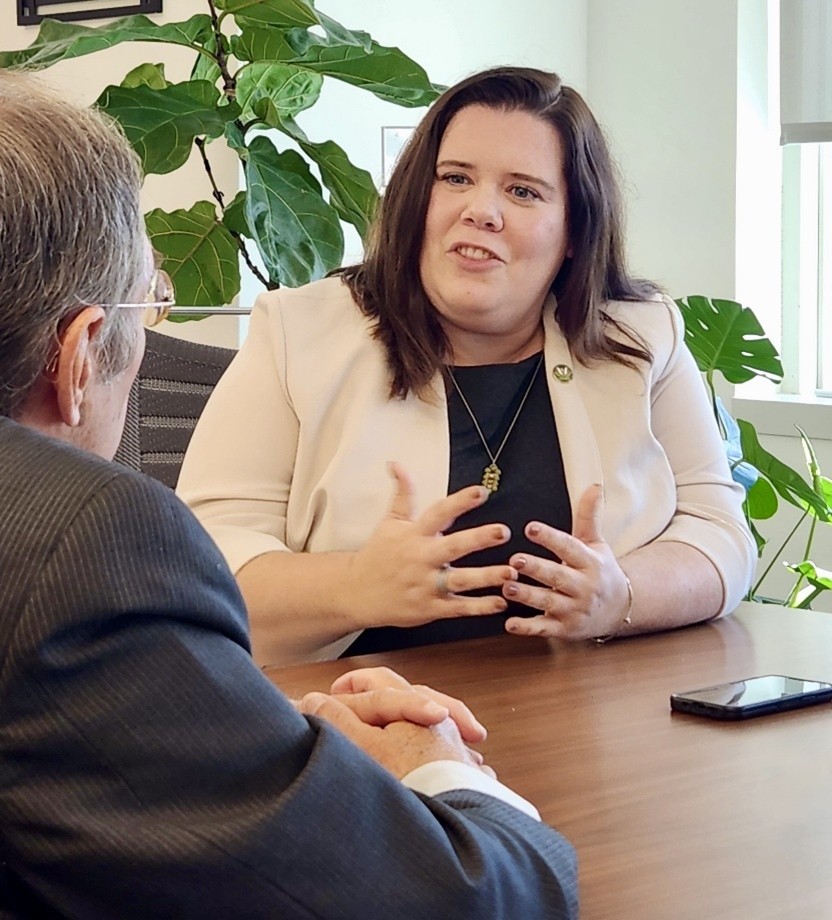
We asked her about how she has applied her stellar legal training and experience in her FERC role. “Being a litigator before coming to this role, I know how to attack agency orders.” She can help to get orders written in a way to better sustain challenges like those she herself has brought. “It’s important to me that the orders we issue are legally durable,” she informs us. She also points out that “so much of what we do is building relationships and obtaining consensus among the Commissioners.” She sees a relationship between that and advocating to a tribunal to adopt her positions.
And she assures us that she really is as enthusiastic about the role of Commissioner as she always appears to be at the Sunshine Act Meetings to which we are all glued to the internet to observe. (But she has never informed her parents that they can live stream these events.) Being a FERC Commissioner “was not on my 10-year horizon, so it was a real surprise and honor to be considered and chosen.” Self-described as “nerdy at heart,” she loves the subject matter at the agency, particularly “at a moment when things are changing dramatically.”
Challenges and opportunities of load growth unify Commissioners to achieve the “same overarching goal.”
She sees these challenges and opportunities presented by load growth as having “a unifying effect” on the Commission as they each try to grapple to achieve the “same overarching goal.” She regards it as a good challenge for FERC to tackle, and that it has unleashed “creativity and nimbleness” within the energy sector. Calling FERC a “fantastic place to be,” she also praised the high quality and dedication of the Staff, who are “second to none.”
Noting that she worked with disparate groups previously to reach accommodation, including among “blue” state groups and “red” state groups, she sees the same need to do so here. In fact, she strives to achieve consensus orders by appropriate compromise, when possible, rather than having more extreme positions voted out by a majority with minority dissents. That said, she does not hesitate to issue a dissent when full agreement is not possible. She sees all her colleagues as “dedicated to public service in especially challenging times in the energy industry.”
Getting to FERC From Michigan Via West Virginia
We surmised that she must have had some experience getting along with different kinds of folks from her own life experiences in different regions of the country. She grew up in Michigan where all her family still resides. This top law school star was home schooled by her parents along with her three siblings. Her mother, with a high school education, researched teaching skills and curricula and gave her children an “incredible K-12 education.” She also strove to have her children overcome any fear of public speaking by founding a monthly public speaking group with other kids, beginning when Commissioner See was seven years old, to give a two-minute speech. She obviously accomplished that mission quite well also, with Commissioner See never being nervous over the size of any audience before whom she may appear. Commissioner See went to college in Virginia before obtaining her New England law school education and then working in D.C., including as a law clerk to retired D.C. Circuit Judge Thomas B. Griffith. The Judge had advised her to be open to new opportunities as they come along. And one such unforeseen career-altering opportunity presented itself. She was urged by a friend to pursue the Solicitor General post in West Virginia, and in that capacity came to have a greater appreciation of the importance of states in pursuing their own remedies to common problems, a lesson that stays with her in her present role. In D.C., she believes it is easy to “think all important things happen at the federal level.” So, a strange twist of fate gave her a new perspective and insight. She also met her partner in West Virginia, so she has many reasons to be endeared to the Mountain State. “It’s home!”
Of course, we had to ask if she had developed any connection with now-former Senate Energy and Natural Resources Committee Chairman Joe Manchin of West Virginia prior to her nomination. Surprisingly, she said that she never met him before she came to his office for a visit after her nomination was submitted to the Senate for confirmation. He even asked her how it could be that this was the first time they were meeting.
She brought an administrative law expertise to FERC through her work at Gibson, Dunn & Crutcher. Telecom, securities, and accounting were her primary focus. As the head of the state appellate office in West Virginia for 7 years, she dealt with all subject matters, from criminal to civil, from tax to consumer protection. She was humble enough to volunteer how her office lost its first Supreme Court case 9-0 on a tax issue. Of course, she was then advocating for the positions of her client. Now she is an adjudicator and policy decision-maker of her own – something she calls more challenging than having a position assigned to her to advocate.
West Virginia was focused on energy and environmental issues during her time in office there (as it still is) so she became more involved in FERC-related matters than previously. In that connection, she volunteered how important it is to have a full contingency of five Commissioners at FERC with a diversity of backgrounds and expertise. For example, she was more steeped in Natural Gas Act issues immediately before becoming a FERC Commissioner. She welcomes colleagues who “have spent their whole work lives on electric market issues.” She learned from her appellate judge that neither he nor anyone has expertise in every subject matter that comes up and we all need to reach out to others for input. She has seen draft orders become “significantly improved” by the various review within different offices with different subject matter expertise.
Getting Underway at FERC as a Non-FERC Practitioner
She began by hiring her Office Staff and decided that she primarily wanted people with experience working within the agency since she had not practiced there herself. She considers herself fortunate to have several advisors who have been at FERC for a decade or more and can tell her “not only what was going on in a case but the history of how it had moved through the Commission” as well as simply how the agency works. On the other hand, to have balance she hired a couple team members from outside FERC to bring different experiences and perspectives. Then she pursued her mission from the standpoint of her background and insights gleaned from past experiences and interactions from players in the real world.
“I come with real respect for the state and regional perspective.”
“I come with a real respect for the state and regional perspective.” Some people asked her why she would want to come to a federal regulatory agency when she was so well known for successfully challenging such action at the Supreme Court with respect to the Environmental Protection Agency. Her response is that being with a State allowed her to see “the benefits of federal regulation when it is done well because there are some things that States cannot do individually.” By the same token, she has seen “the real consequences when it does go too far or you are not considering the compliance clash of a rule or regulation.” She recalled talking to her state industries as to what they would have to do to comply with federal requirements. This insight causes her to question, “Is that value proposition really there?” when faced with a proposed rule.
She confirms that she considers herself bound to approve an application that passes the broad just and reasonable and not unduly discriminatory standard even if it is not necessarily what she would have chosen in the first instance. “I care a lot about the law, and I care a lot about predictability.” She adds that she wants to make sure that the agency is transparent in following its legal requirements. This hearkens back to her days in West Virginia when she spoke to the power companies there and they would tell her that it is as important to know what the rule is expeditiously and to have confidence in the strength of that rule.
She also observes that she is very impressed when a coalition of states comes forward with a joint position because she knows how hard it is to achieve consensus while also considering what might be lost in a uniform view. She looks at whether regional approaches make the most sense.
On policy matters, Commissioner See also looks beyond whether something is legally allowed to determine how it is going to affect ratepayers. Her advice to practitioners is that we should not just argue the fine legal points but also explain the real-world consequences of a decision. And in “plain English.” She also finds prefiling meetings to be extremely helpful and encourages them.
Interestingly, with her broad administrative law expertise, she has observed that at FERC “most of what we do is reactive, and that is not typical at all agencies.” By that she means, “we get a lot of FPA Section 205 filings, a lot of RTOs and utilities and others coming to us” seeking FERC authorizations so that responding to these requests is most of what the Commission does. It is a minority of cases where the Commission issues a mandate of its own creation, unlike most administrative agencies.
And she sees that affordability and market issues that FERC has a role in have affected people’s lives to the point that FERC is increasingly covered in the trade press and the popular press. She considers it appropriate to “put a spotlight on the consequences for real people of what it is that we’re doing.” She welcomes this coverage as keeping “all of us accountable for our decisions.”
Getting Infrastructure Built Without Undue Delay a Key Goal
A major goal of Commissioner See’s is to bring about more infrastructure. More pipes and more wires. “We are not responsible for all the permitting. But where we are, I have been focusing on how we can make sure we are doing our job well on the front end – looking at all the information in the record and how we can speed up that process but keeping the tension right between thoroughness and speed.” She touts FERC’s recission of the rule in Order No. 871 imposing a 180-day waiting period on acting on a pipeline certificate after it is issued. She takes the position that “there are still appropriate avenues to challenge our orders and to have injunctive relief in appropriate cases.” But she states that once the agency has done its thorough review of whether a certificate is in the public interest there should not be an automatic delay in giving it effect, calling 180 days “a long time when a construction window is sometimes very short” so that a year’s delay may be caused. She explains that “we are looking at very urgent needs” to build gas and electric grid infrastructures on a timely basis. “I am committed to doing what we can to shorten regulatory delays.”
“I am committed to doing what we can to shorten regulatory delays.”
Obviously, Commissioner See has brought a breadth of experience to bear at FERC without direct FERC experience to start from, and has used those experiences to help make FERC operate more efficiently and effectively. She is a role model for anyone considering venturing into a career path by seizing unexpected opportunities as they arise. She had a mentor in Judge Griffith, who gave her the sage advice to be flexible in taking on new challenges. Now she can impart the same message to others through her own example as a superb regulator by utilizing the skills and lessons she learned along the way because of her willingness to embrace adventures.
See Speaks
Early Bird or Night Owl: Early Bird.
Favorite Season and Why: Fall. Love crisp air, it’s so beautiful “and I love pumpkins.”
Most Admired Public Figure: Abraham Lincoln.
2026 Winter Olympics Sport for You to Win a Gold: Skiing, to make up for not having that skill.
Advice to Lawyers: Please write in plain English.
Item to Take to a Desert Island: Uber Eats App – and assume that it works on a desert island.
Advice for an Incoming FERC Commissioner: Don’t be afraid to admit what you don’t know and take advantage of the incredible expertise of the FERC Staff we have.
Most Influential Person in Childhood: My mom.
Favorite Comedy: Clue.
Most Beautiful Place Ever Seen: Scotland – the Island of Skye and the Orkney Islands.
Most Proud Of: My team here and my team at my last job. Seeing them succeed and how strong they are and how well they work together.
On Bucket List: Travel to Southeast Asia and New Zealand.
Something Checked off Bucket List: Travel to India with an anti-sex trafficking NGO.
Most Surprising Thing About Working at FERC: How busy we are. “No one tells you.”
Wolverine or Mountaineer: Mountaineer for football and Red Wings for hockey.